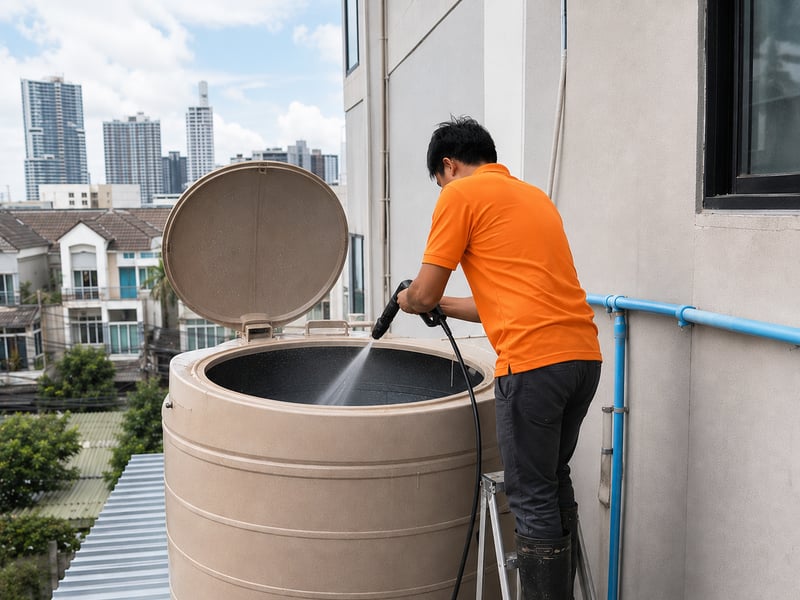
Bangkok water tank cleaning for houses, condos, and rooftop stainless steel tanks. We drain, scrub, sanitize, and refill, removing the bacteria, algae, and sediment that build up in tropical heat. Most homes here have never had theirs cleaned.
Quick response, English and Thai speaking. Always on time. 100% Guarantee.
Every drop of water you use in your home, the water you brush your teeth with, the water you cook your rice in, the water your children bathe in, has been sitting in your water tank. For days. Sometimes weeks. And in most Bangkok homes, that tank has not been cleaned in years. Some have never been cleaned at all.
What is sitting at the bottom of your tank right now is sediment from the municipal supply, biofilm growing on the walls, algae that has had time to spread, and bacteria multiplying in warm, dark, still water. You cannot see it. You cannot always smell it. But it is there, and you are drinking it.
The early signs of a contaminated tank are subtle, which is why so many people miss them for years.
Any one of these on its own is easy to dismiss. Together, they are your tank telling you it needs help.
Warm, still water is the perfect environment for bacterial growth. E. coli, coliform bacteria, and in some cases legionella thrive in tanks that sit between 20 and 35 degrees, which is most of the year in Bangkok. The chlorine added at the treatment plant breaks down long before water reaches your tap, leaving nothing to stop new growth.
That slippery, slightly slimy layer you sometimes feel on the inside of a glass left out overnight is biofilm. In your tank, it coats the walls, the floor, and the inside of every pipe. Biofilm protects the bacteria living inside it from chlorine, which is exactly why a quick chemical flush does not solve the problem. It has to be physically scrubbed off.
Bangkok's water travels through old pipes carrying minerals, rust particles, and dust. Once it enters your tank, the heavier particles settle to the bottom and form a layer of grit and silt. Over years, this layer can be several centimeters deep, and every time the pump kicks on it stirs some of it back up into the water you use.
Tank lids crack. Seals fail. Insects, lizards, and the occasional rodent find their way in. We have opened tanks and found dead pests, leaves, and debris that nobody knew was there. The water sitting on top of all that is the water coming out of your tap.
Your team arrives, inspects the tank, and identifies the type (stainless steel rooftop, concrete underground, or fiber composite), capacity, and condition. They close the incoming municipal supply valve, shut the outflow to the house, and turn off the booster pump. For underground tanks, they set up ventilation and confined-space safety equipment before any work begins.
Remaining water is pumped out through the drain port, not the outlet, because sludge sits below the outlet and would otherwise be left behind. The thick layer of sediment, sludge, and biofilm at the bottom is scooped out, captured, and disposed of properly through the drainage system.
Every interior surface, walls, ceiling, floor, baffles, and corners, is jet-washed with a high-pressure spray gun. Stubborn algae, mineral deposits, and biofilm in seams and corners are scrubbed off by hand with stiff brushes. The slurry residue is then wet-vacuumed out so nothing is left behind.
Once the tank is physically clean, food-grade chlorine bleach is applied across all interior surfaces at the concentration recommended by MWA and WHO for residential drinking water. The solution sits for 30 minutes to kill any remaining bacteria, then the surfaces are wiped down. After the tank is refilled, the lines are flushed thoroughly so no chlorine taste or smell remains in your water.
While the tank is empty, your team inspects every valve, joint, gasket, and pump component. The float valve (which fails most often), the foot valve, ball valves, the lid seal, and the pump itself are checked. If something needs replacing, you are shown the issue with a photo, given a clear quote for the parts and labor, and the work only happens if you approve.
The supply is reopened, the tank refills, and your team runs the taps for a few minutes to flush residual chlorine through the pipes. The pump is restarted, water pressure is verified at every fixture, and the lid is sealed back properly to keep insects and debris out.
You receive before and after photos showing exactly what was sitting in your tank and exactly how it looks now. We note any maintenance items to watch, schedule your next clean (every six months is what the Metropolitan Waterworks Authority recommends), and leave you with water that is finally safe.
Included: full drain, sediment removal, high-pressure scrub, bleach disinfection, lid and fittings inspection, refill, line flush, before and after photos.
Extra cost if needed: float valve replacement, foot valve replacement, ball valve replacement, pump repair or replacement, lid or seal replacement. You see the issue, you get a quote, you decide.
The Metropolitan Waterworks Authority recommends cleaning residential tanks every six months. In a hot, humid climate like Bangkok's, biofilm and bacteria establish themselves faster than in cooler regions. Twice a year keeps the tank in baseline condition. Once a year is the absolute minimum. Going longer than that means cleaning a tank that has had time to grow a real ecosystem inside.
If you have just moved into a new home or condo, the safest move is to clean the tank before you settle in. You have no idea when the previous owner cleaned it, or whether they ever did.
Your team are Thai professionals trained in tank cleaning, plumbing, and confined-space safety. Booking, questions, photos, and follow-up are all handled in English, so nothing gets lost between you and the technicians on the day.
You smell something off in the water. Trust your nose. If the water smells musty, earthy, or like a swimming pool, the tank needs attention.
You just moved in. Clean the tank before the toothbrushes come out. You inherited whatever the last owner left behind.
It has been more than six months, more than a year, or you genuinely cannot remember the last time. Any of those is your answer.
After a flood or major plumbing work. Both events introduce contamination into the tank, and the only fix is a full clean.
You see anything floating, settling, or growing. If you can see it, it is well past time.
Message us on LINE, WhatsApp, or use the contact form. Tell us your tank size, whether it is above ground or underground, and your address. You get a quote within the hour and most jobs are scheduled within the same week. Your tank is cleaned in a few hours and your water is back, cleaner than it has ever been since the day it was installed.
Fast response, English and Thai language, available every day.